

Chiaroscuro, Part III: Control, Containment, and the Discipline of Light
Shaping tools, spill control, and maintaining contrast in complex environments
In the first two parts of this series, chiaroscuro was established as a directional lighting system and then translated into practical portrait execution. The emphasis was placed on ratios, exposure placement, lens behaviour, and the way film records sculptural light when those decisions are made deliberately. This third part moves the discussion further into control.
Once a lighting ratio has been established, the primary threat to chiaroscuro is not the key light itself, but the uncontrolled behaviour of light within the space. Spill, secondary reflections, environmental bounce, and ambient lift can gradually erode contrast and flatten structure, particularly in confined or visually complex interiors. Cinematographic lighting does not resolve these problems by increasing output. It resolves them through containment, subtraction, and disciplined control of where light is allowed to travel.
This article examines how chiaroscuro is maintained when the environment becomes an active variable rather than a neutral backdrop, using a constructed interior night scene at the Liquid Light studio as a working case study. All images shown were developed and scanned in-house at Liquid Light Lab, using the same controlled workflows available for client film processing and scanning.

Directional chiaroscuro constructed inside a fully darkened interior. Controlled light shapes the subject through venetian blinds acting as functional flags, while spill and bounce are suppressed to preserve shadow authority and sculptural depth on black and white film.
Containment Before Illumination
Chiaroscuro fails most often not because the key light is incorrectly placed, but because too much light is allowed to escape. In small rooms especially, uncontrolled bounce rapidly lifts the shadow plane. Walls, ceilings, floors, and reflective surfaces all become secondary light sources unless they are deliberately neutralised.
The first decision in any chiaroscuro setup should therefore be containment, not illumination. Before a lamp is introduced, the space must be assessed in its unlit state. With the room lights off, the baseline darkness becomes visible. This darkness is not absence; it is the structural foundation on which the lighting architecture will be built.
In the session discussed here, the room was completely dark without the lights. That condition is critical. It means that every illuminated surface in the final image exists as the result of a conscious decision. Any lift in the shadows comes from reflection or spill that can be measured, shaped, or removed.
Darkness, in this context, is not an aesthetic choice. It is the consequence of controlled light.
Flags as Functional Tools, Not Accessories

Venetian blinds functioning as environmental flags: shaping spill, intercepting reflections, and preserving shadow authority while introducing rhythmic structure across the frame.
In cinema, a flag is defined by function rather than form. Any object that blocks, shapes, or subtracts light is acting as a flag, regardless of whether it is a purpose-built grip accessory.
Doors, walls, furniture, curtains, and blinds all qualify if they perform that role. In this interior scene, venetian blinds served multiple functions simultaneously. They created environmental texture, producing rhythmic shadow bands across the subject, while also blocking direct spill from the key light and intercepting reflections that would otherwise lift the shadow plane.
This is not improvisation. It is orthodox cinematographic practice. Historically, shutters, window mullions, and architectural recesses were used in precisely this way. The principle remains unchanged: light is shaped by what it cannot pass through.
Treating the environment as a set of potential flags allows chiaroscuro to be built in spaces that would otherwise appear unsuitable. The requirement is not scale, but control.
Negative Fill and the Preservation of Shadow Authority
Once the key light is placed, attention must turn to the shadow side. In many interiors, the shadow plane is lifted unintentionally by reflected light. White walls are the most common cause, but floors, ceilings, and even light-coloured clothing can contribute.
Negative fill is the primary tool for restoring contrast. Black fabric, dark surfaces, or absorbent materials are introduced not to create darkness, but to allow darkness to remain.
In this session, dark fabrics were placed strategically around the set to absorb reflections and prevent unwanted bounce. In confined spaces, this step is essential. Without it, even a well-shaped key will gradually lose authority as light ricochets back into the scene.
Negative fill was used selectively rather than globally. Only areas that threatened to flatten the shadow plane were suppressed. This preserves depth without turning the image into a void. Chiaroscuro requires readable shadows with weight, not empty darkness.
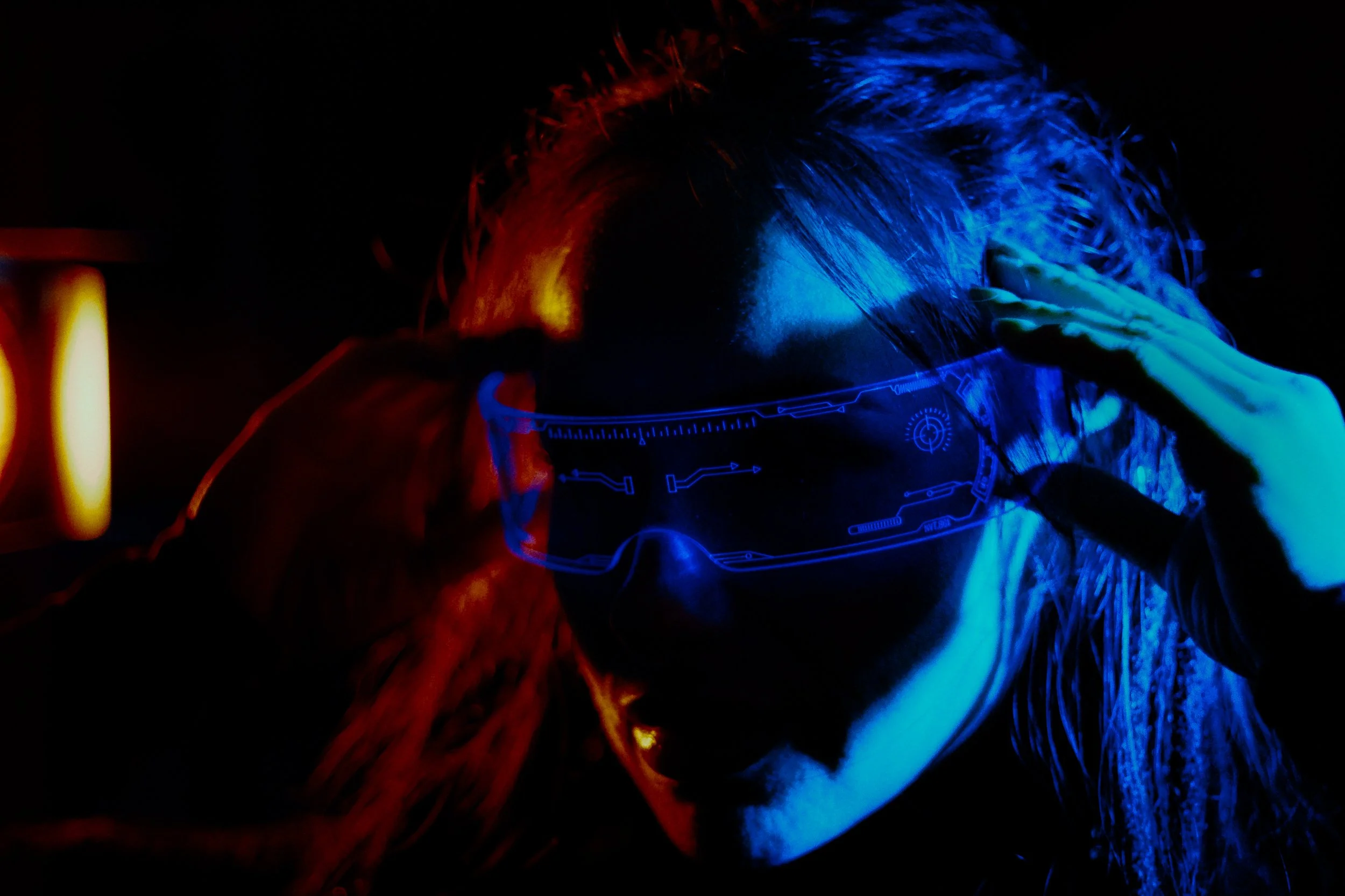
Negative fill is applied to the frontal plane to hold separation between opposing key sources, while the visor provides a controlled bridge between the illuminated sides without colour contamination. Visible lamp placement and flagging prevent lateral spill and preserve contrast integrity across the face.
Film responds particularly well to this approach. When bounce is controlled physically, the negative records shadow density with texture rather than noise, a difference that becomes immediately apparent in scanning and printing.
Shaping Light in Depth, Not Just Direction
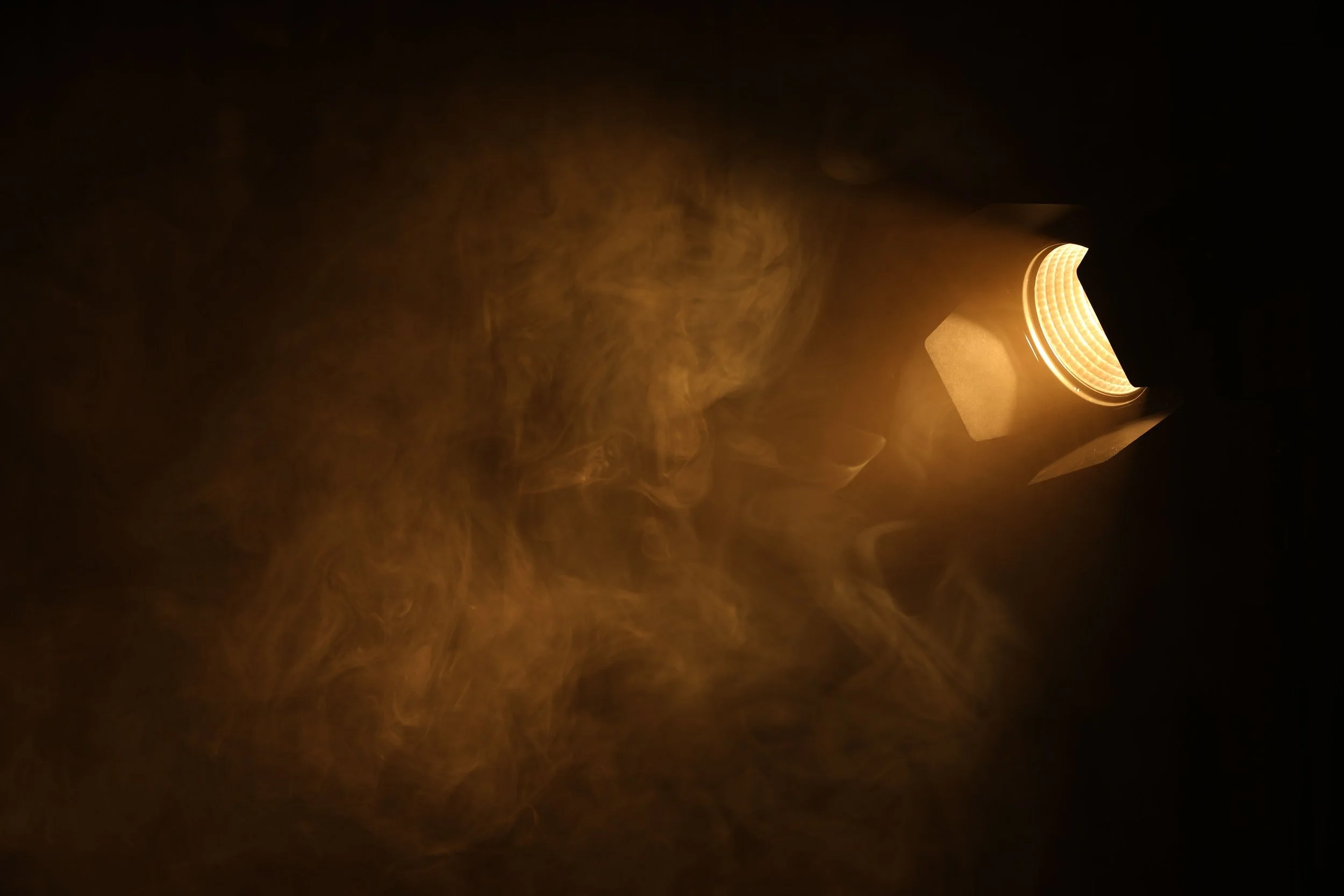
I used barn-doored continuous light with honeycomb grid, colour filtration applied at the lamp, and smoke used to visualise beam shape and control falloff before the light enters the set.
Shaping light is often misunderstood as a matter of narrowing the beam. In practice, depth control is equally important. Where the light falls off, and how quickly, determines whether a scene reads as dimensional or flat.
Parabolic modifiers are particularly effective here because they project light forward rather than outward. This allows the subject to be illuminated while the background falls away naturally. In small rooms, this characteristic reduces reliance on excessive flagging while preserving clarity of direction.
In the constructed interior scene, two continuous light sources were used, both fitted with barn doors and honeycomb grids. The barn doors controlled lateral spill before the light entered the space, preventing walls and ceilings from becoming secondary sources. The grids further narrowed the beam angle, ensuring that illumination remained intentional rather than ambient.
Colour filtration was applied at the lamp. This ensured that chromatic behaviour was part of the lighting architecture itself. The colour existed as light interacting with surfaces, not as an overlay introduced later.
All images in this shoot were photographed using the Zeiss Pancolar 50 mm f/1.8. Its optical design produces high microcontrast and firm tonal separation, reinforcing the sculptural intent of the lighting and preserving clear transitions between illuminated and shadowed planes.
Lighting Hierarchy and the Role of Secondary Sources
Chiaroscuro does not forbid secondary light sources. What it forbids is equality.
In this session, a second light was introduced only to provide selective information: eye visibility, visor legibility, and minimal plane separation. It was not intended to fill the shadows or alter the established ratio. Its output was kept low enough that removing it would not collapse the scene, only reduce clarity.
This distinction matters. A subordinate shaping source supports chiaroscuro. A fill source undermines it.
The test is simple: if the secondary light were removed, would the image still function? If the answer is yes, the hierarchy is intact.
Reflections, Smoke, and Spectral Behaviour in Colour Film
Complex interiors often include reflective or translucent materials such as Perspex, moisture, smoke, or polished surfaces. These introduce spectral behaviour that complicates colour work, particularly on colour negative film.
Small changes in angle can alter which wavelengths dominate a reflection. Blue sources often bleed into green; amber sources frequently contain green energy. When contrast and saturation are increased during scanning, these differences become visible.
This is not an error. It is a physical property of light interacting with materials.
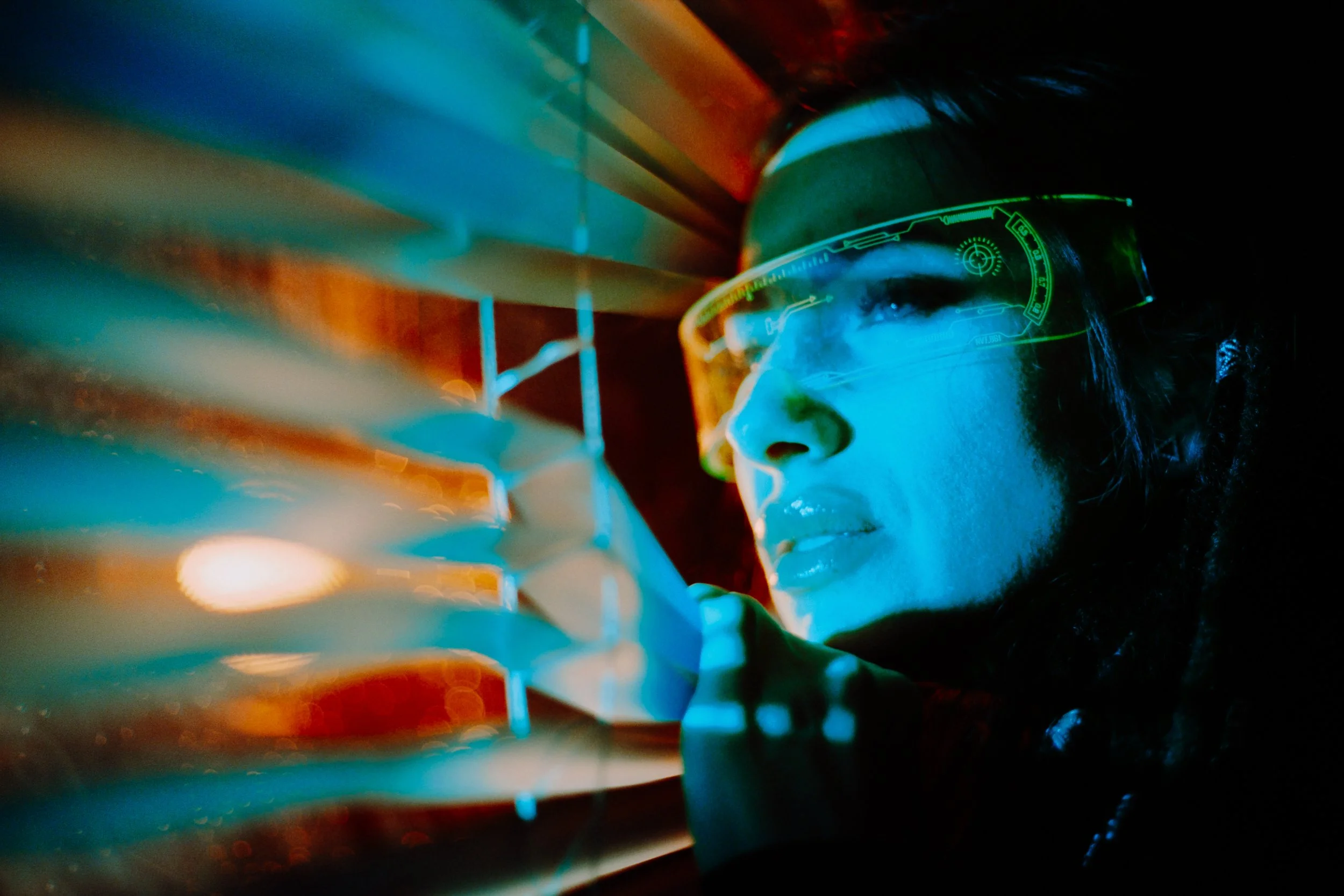
Reflections and smoke reveal spectral behaviour in colour negative film, showing wavelength shifts and beam structure under controlled exposure.
Smoke was introduced in some frames not as atmosphere for its own sake, but as a shaping tool. Smoke visualises beam structure, softens transitions selectively, and acts as a semi-flag by absorbing and scattering light before it reaches the subject or background. Used sparingly, it allows depth to be expressed without flattening contrast.
The solution to spectral variation is not neutralisation, but exposure discipline and structural consistency. In cinema, such variation is managed shot to shot, not eliminated globally.
Maintaining Chiaroscuro Across a Sequence
As environments become more complex, consistency becomes a matter of process rather than appearance. Chiaroscuro survives across frames when the same decisions are repeated: establish the shadow side first, set the ratio deliberately, contain spill physically, and place exposure for density.
When these steps are followed, lenses and film stocks can change without breaking continuity. The images may differ, but they belong to the same lighting architecture.
At this point, chiaroscuro ceases to be a look and becomes a working system.
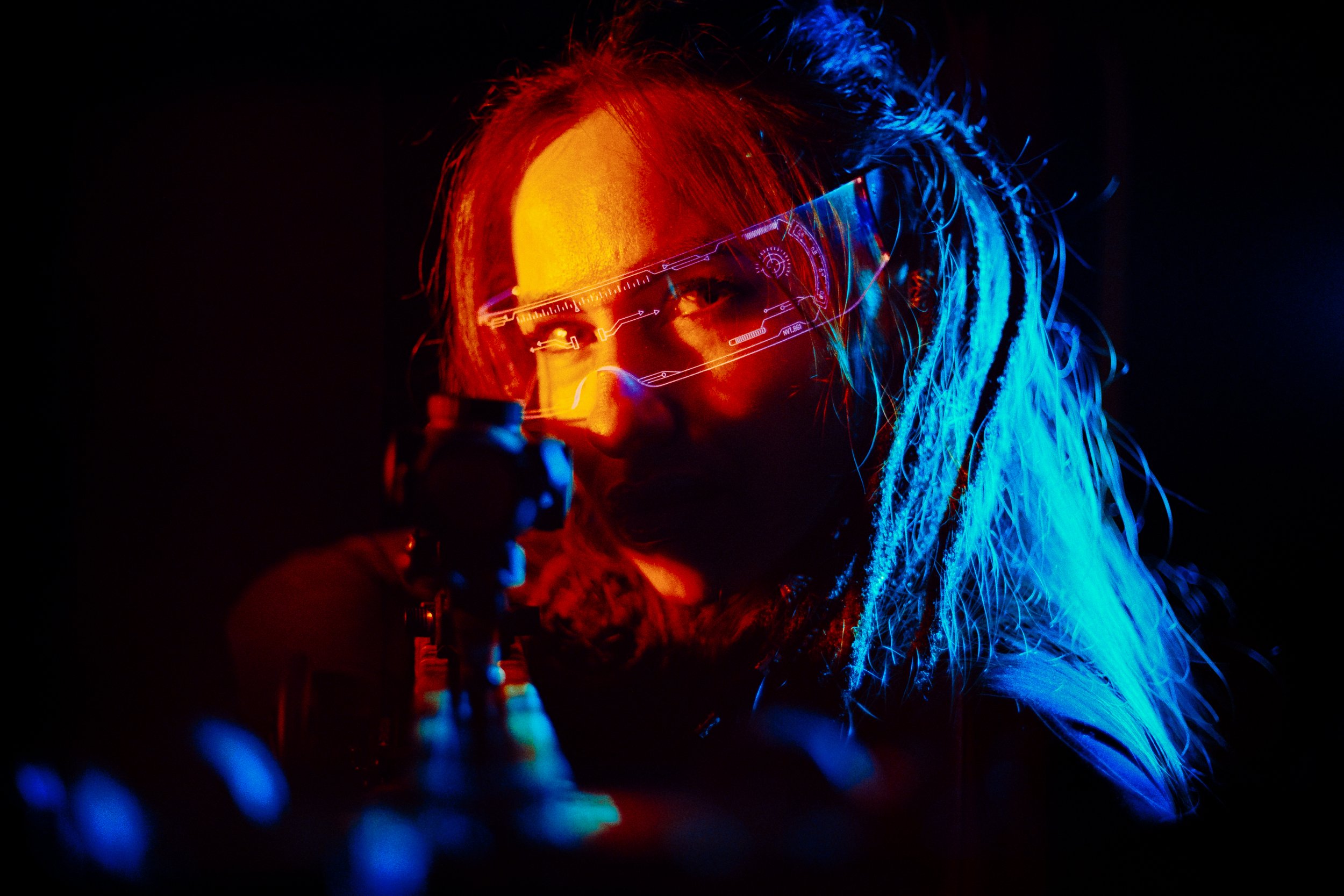
Final refinement achieved through subtraction: spill suppressed, bounce removed, and visibility reduced to preserve contrast and structural depth.
Refinement Through Subtraction
The final stage of refinement is restraint. At a certain point, the most effective action is to stop adding and start removing. Remove bounce. Remove spill. Remove excess visibility. Allow darkness to carry weight.
In still photography, this discipline is often abandoned in favour of post-production correction. In analogue work, it must be resolved on set. The negative will faithfully record whatever lighting architecture it is given.
When containment is prioritised, film becomes an ally rather than a limitation.
Conclusion: Control as the Foundation of Chiaroscuro
Chiaroscuro in complex environments is not about dramatic lighting. It is about control.
Shaping tools, flags, negative fill, and environmental suppression are the mechanisms by which contrast and directionality are preserved when the space itself resists them. The interior night scene examined here demonstrates that chiaroscuro does not require ideal conditions. It requires intentional decisions, physical control, and an understanding of how light behaves once it leaves the lamp.
When these elements align, the result is not a stylistic effect but a coherent visual structure. Film records that structure as density, and the image carries depth because it was built to do so.
This methodology underpins all commissioned portrait work at Liquid Light Whisperer. The lighting is designed, contained, and resolved before the shutter is released. The negative is the physical record of that decision-making.
By Martin Brown | Liquid Light Whisperer
All portraits were developed and scanned in-house at Liquid Light Lab, Leamington Spa. As their brand Ambassador and Technical Partner, film was provided by Candido Collective to use in this shoot.
Olga Pastushenko modelled for this case study and article - follow her on Instagram.