

Lens, Film, Chemistry — The Three Decisions That Define Cinematic Photography on Film
Introduction
Cinematic photography on film is often discussed in terms of mood or aesthetics, but those descriptions arrive too late in the process. They describe the outcome, not the construction. Long before a photograph acquires atmosphere, presence, or emotional weight, it is defined by a small number of physical decisions that determine how light is interpreted, recorded, and preserved.
In analogue photography, there is no separation between capture and outcome. The photograph is not assembled later from interchangeable parts, nor is its character imposed through post-production. Instead, it is authored through a sequence of irreversible choices made before and during exposure, and completed in development. These choices are not stylistic preferences layered on top of the image; they are structural constraints that shape what the photograph can become.
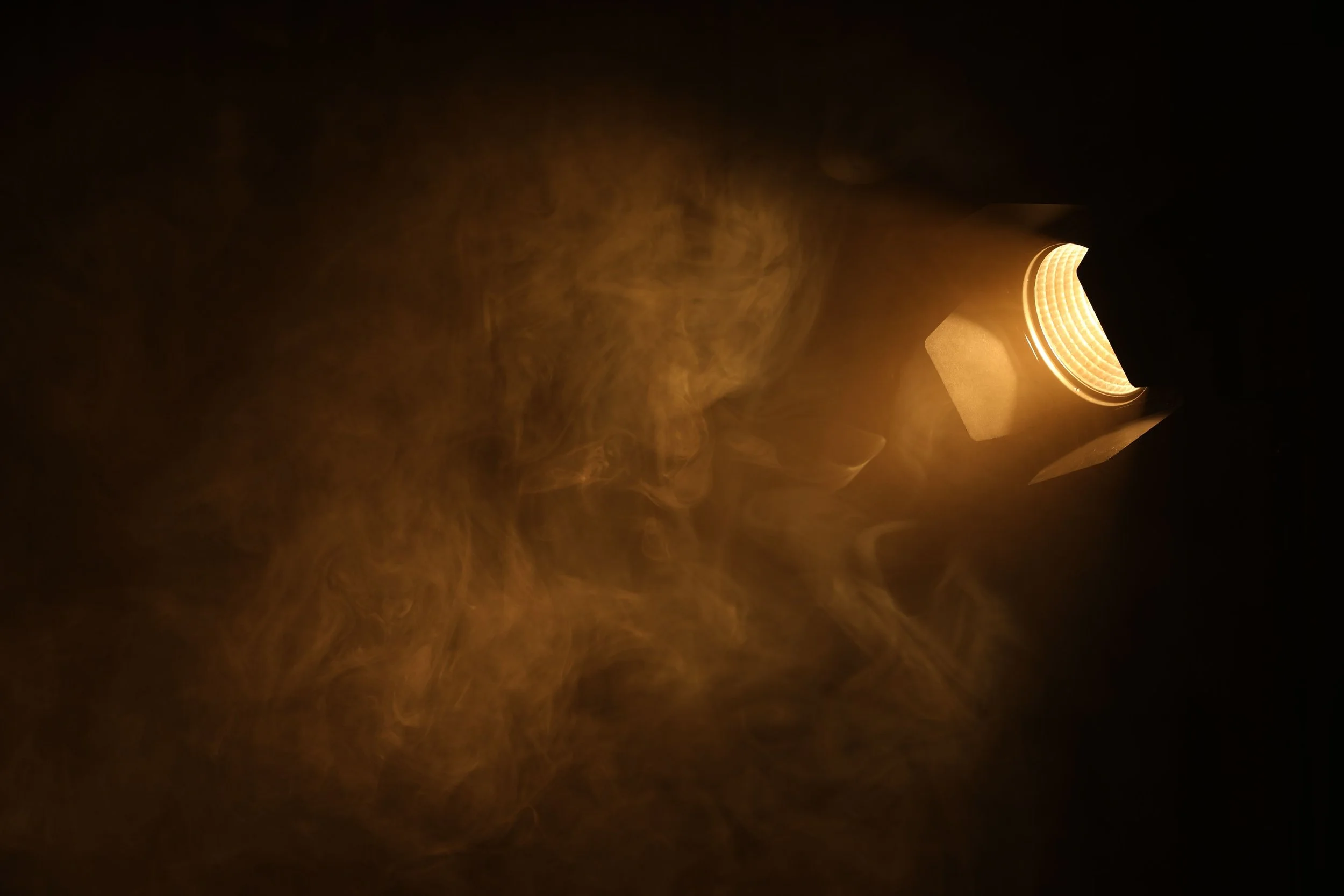
Directional light shaped with barn doors, illustrating controlled illumination before exposure.
Across decades of cinematography and still photography alike, three decisions consistently govern the final image. They operate at different stages of the process, but together they form a closed system. If one is misjudged, the others cannot compensate. When they are aligned, the photograph holds together with coherence and permanence.
Those three decisions are lens selection, film stock, and chemical processing. Respectively, they define how light is drawn, what kind of record is made, and how that record is stabilised over time. Understanding them as a unified structure is essential to understanding how cinematic photographs on film are actually built.
What follows is not a guide to taste or preference, but an explanation of those three decisions as material facts. A cinematic photograph on film is defined not by style or genre, but by three irreversible physical decisions that determine how light is drawn, recorded, and preserved before it ever becomes an image. This is the underlying architecture that governs every photograph made on film, whether acknowledged explicitly or not.
Lens Selection (The Drawing Style)
The first decision governs how light is interpreted before it is recorded at all.
A cinematic photograph on film begins long before exposure. It begins with a decision about how light will be interpreted as it passes through glass. Lenses do not simply transmit information; they draw. Every optical design carries with it a way of shaping transitions, compressing space, and resolving edges. This behaviour is not a matter of sharpness or resolution but of structure. It governs how highlights roll, how mid-tones connect, and how a subject separates from its surroundings without force or exaggeration.
Older optical designs are often described as having character, but that word is imprecise. What they actually possess is a different relationship to contrast and transition. Their correction priorities were not optimised for clinical uniformity across the frame but for coherence. Faces, fabrics, and architectural surfaces are rendered with continuity rather than emphasis. The drawing is calm. Light is allowed to fall away rather than being held abruptly at edges.
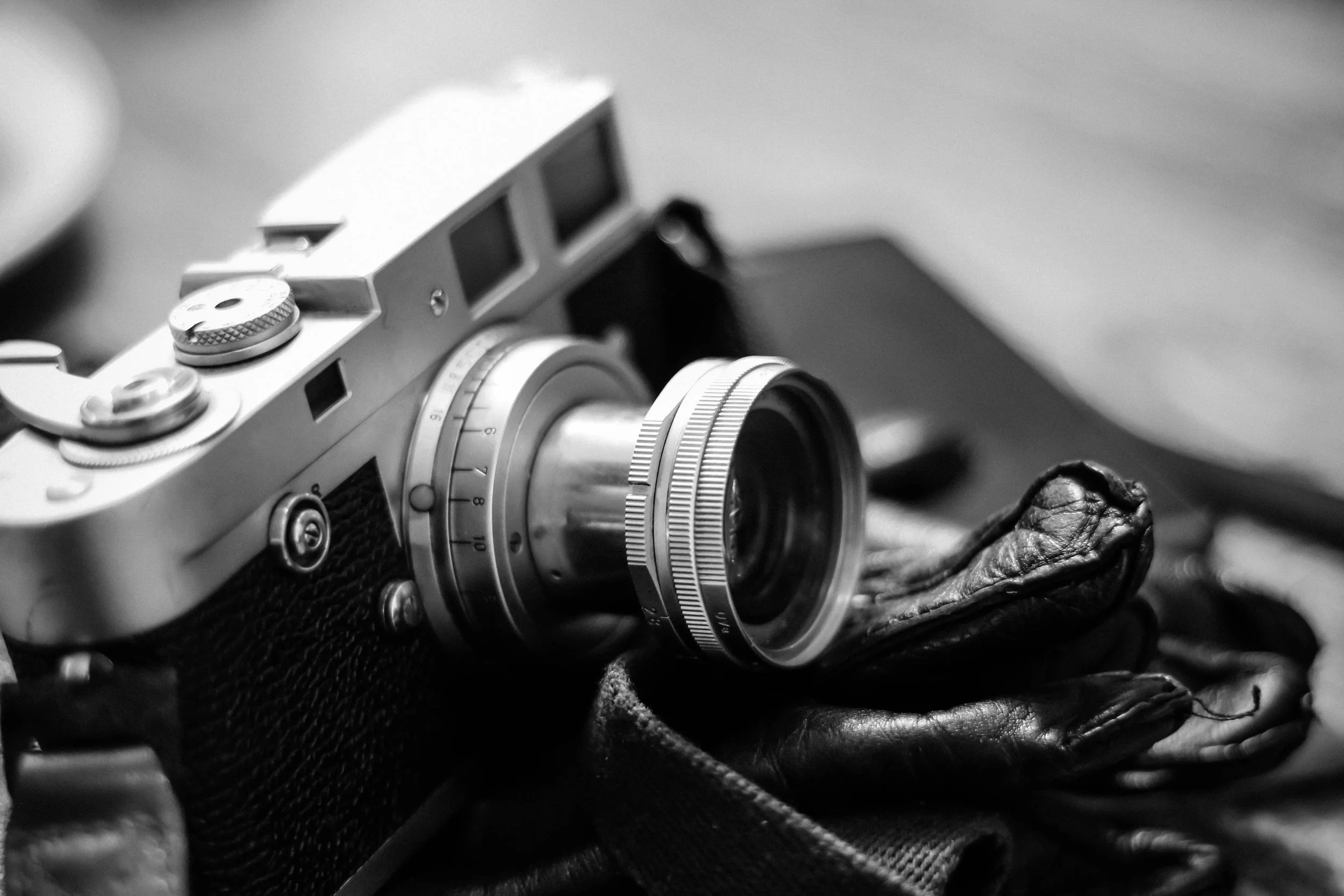
Mechanical rangefinder camera with vintage lens, illustrating how optical design and physical construction shape contrast, transition, and spatial rendering before exposure.
This is why lens choice is not interchangeable. Changing the lens changes the geometry of the image even when the framing remains the same. Perspective relationships shift subtly. Highlights either taper or harden. Skin is either described or interrogated. These differences are not corrected later; they are built into the negative at the moment of exposure. The lens defines how the scene is translated into physical form, and that translation cannot be undone.
In cinematic portraiture on film, lens selection is therefore a primary creative decision. It establishes the visual language before any other variable is introduced. Everything that follows must be aligned with the drawing the lens produces. If it is not, the photograph fractures.
Film Stock (The Record)
The second decision determines what kind of physical record that interpreted light will become.
Once light has been shaped by the lens, it must be received by a medium capable of holding it with integrity. Film is not a neutral container. Each stock is a distinct recording surface with its own response curve, grain structure, and tolerance for contrast. Choosing a film stock is choosing what kind of record will be made.
Some films privilege latitude and composure, holding highlight detail with restraint while allowing shadows to remain open and intelligible. Others embrace grain as a structural element, allowing texture and density to become part of the image rather than an artefact. Colour stocks carry their own spectral biases, shaping how different wavelengths are absorbed and rendered. Black and white stocks define form through tonal separation rather than hue.

35mm motion-picture negative formed into a loop — the physical master record before development and scanning.
The negative produced by a given stock is not simply an intermediate step. It is the master record. It contains all recoverable information and establishes the boundaries within which the photograph can exist. Exposure decisions are made with this in mind. There is no assumption that extremes will be rescued later. Instead, the record is built deliberately, with attention to where information is placed and how it will behave under development.
This is where cinematic discipline enters still photography most clearly. Motion picture stocks, for example, are designed to be stable, predictable, and consistent across scenes. They reward careful metering and punish approximation. Other films invite a more expressive approach, allowing density and grain to become active participants in the image. Neither approach is superior. What matters is coherence between intent and medium.
Film stock selection determines the nature of the record itself. It defines what the photograph can truthfully hold and what it will quietly discard. Once exposed, that decision is fixed.
Chemical Processing (The Permanence)
The third decision governs how that record is stabilised, separated, and made durable over time.
The final decision is often the least visible but the most consequential. Development is not a mechanical necessity; it is an extension of authorship. Chemistry does not simply reveal the image latent in the film. It shapes density, separation, and tonal architecture at a fundamental level.
Different developers act on silver in different ways. Some prioritise speed and uniformity. Others work slowly, allowing highlights to compress while shadows gain structure. Pyrogallol-based developers, for example, interact with the emulsion in a manner that produces proportional stain alongside silver density. This stain becomes part of the image, contributing to tonal depth and long-scale separation that remains stable over time.
Processing choices determine how the negative will age, how it will scan, and how it will print. They influence not only appearance but permanence. A well-developed negative is resilient. It carries its tonal information clearly and consistently, decades into the future. This is not an abstract concern. The physical negative is the enduring object. Scans are interpretations of it. Prints are translations. The negative remains.

Hand development in open trays allows tonal structure, highlight compression, and negative longevity to be controlled at the chemical stage.
Chemical processing is therefore not a place for automation or indifference. Small variations matter. Temperature control, agitation rhythm, dilution, and timing all influence the final structure of the image. These are not stylistic flourishes; they are material facts. They decide whether the photograph holds together as a physical artefact.
Recomposition
These three decisions are inseparable. Lens selection defines how light is drawn. Film stock defines how that light is recorded. Chemical processing defines how the record is stabilised and given permanence. If any one of these is misaligned, the photograph loses coherence.
Cinematic photography on film is not a style applied after the fact. It is the result of deliberate, physical choices made in sequence, each one constraining and informing the next. The photograph exists only where these decisions agree.
This is why film remains a medium of consequence. It does not permit shortcuts. It requires authorship at every stage, and it rewards those decisions with images that are structurally complete, materially stable, and capable of enduring as records rather than impressions.
A finished photograph is not the result of a single act. It is the outcome of three aligned decisions, each made with intent, each irreversible, and each visible in the final image to anyone who knows how to look.
By Martin Brown | Liquid Light Whisperer
You too can have your images made permanent, developed and scanned in-house at Liquid Light Lab, Leamington Spa.