

When the Light Misbehaves – The Beauty of Imperfection in Film Photography
In the world of film, perfection doesn’t exist — and that’s the point. Every roll carries a trace of risk. A flicker of light might slip past a seal. A frame might shift by a fraction. Grain might swell unexpectedly in the shadows. These are not errors to correct. They’re the heartbeat of something real.
At Liquid Light Whisperer, those marks of imperfection aren’t flaws. They’re fingerprints — small proofs that every image was made by hand, in light, with care, and without the safety net of an undo option.

Test frame made on the 1936 Zeiss Sonnar 85mm with Rollei RPX 400 in pyro developer. The parallax wasn’t compensated for — and that slight misalignment gave the portrait its atmosphere in framing.
The Honesty of Imperfection
Film is alive. It bends, reacts, bruises, and surprises. The negative that emerges from a tank of developer isn’t just an image — it’s a physical trace of chemistry, time, and touch. Every variable, from water temperature to the pace of agitation, leaves its mark. When I’m developing client images in the Liquid Light Lab, I love it when the scans show me something completely new that happened by chance.
That’s what gives film its authority. It isn’t about control; it’s about truth. The light that burned through a lens and struck the emulsion really existed, in that moment, in that room. When a portrait shows softness at the edge or a slight vignette around the frame, it’s the medium showing you how it breathed.
These irregularities are not distractions. They’re what makes a photograph feel honest — the visual equivalent of texture in a voice.
Light Leaks and Flares: When the Scene Pushes Back
Open a camera back too soon, and light rushes in like a ghost. A flare burns through the edge of a portrait; a veil of gold drifts across an eye. What should have ruined the frame instead gives it life.
Light leaks are moments when the environment asserts itself. They remind us that film is not a sealed circuit. It’s open to the world.
Certain vintage optics — especially the uncoated pre-war lenses often used at Liquid Light Whisperer — handle stray light like paintbrushes. I refer to lenses as the Drawing Style. They don’t suppress flare; they sculpt it. A Sonnar from the 1930s doesn’t just capture the subject — it bathes it in atmosphere. When that light floods a frame, it turns a photograph into a memory.

Test frame from an early batch of Kodak Vision3 400D, months before release. The emulsion showed severe instability — magenta fogging, uneven dye response, and possible coating faults — turning a defective roll into a study of cinematic imperfection.
Grain as Emotion
Grain isn’t noise; it’s tone made visible. It’s how film breathes. Under light, grain shifts with mood — smooth in calm scenes, coarse in turbulent ones. When a roll is pushed beyond its rating, the silver halides swell, shadows deepen, and emotion grows teeth.
Each film stock has its voice. RPX 400 hums with grit and presence. Vision3 50D glows with cinematic softness. Developed in pyro, those grains etch fine tonal lines that no machine could ever draw.
When clients look at a finished LLW scan or print, they often mention how alive the image feels. That life comes from the grain — microscopic reactions captured in real time, not algorithms. Grain gives tone its breath. It’s how film speaks emotion.
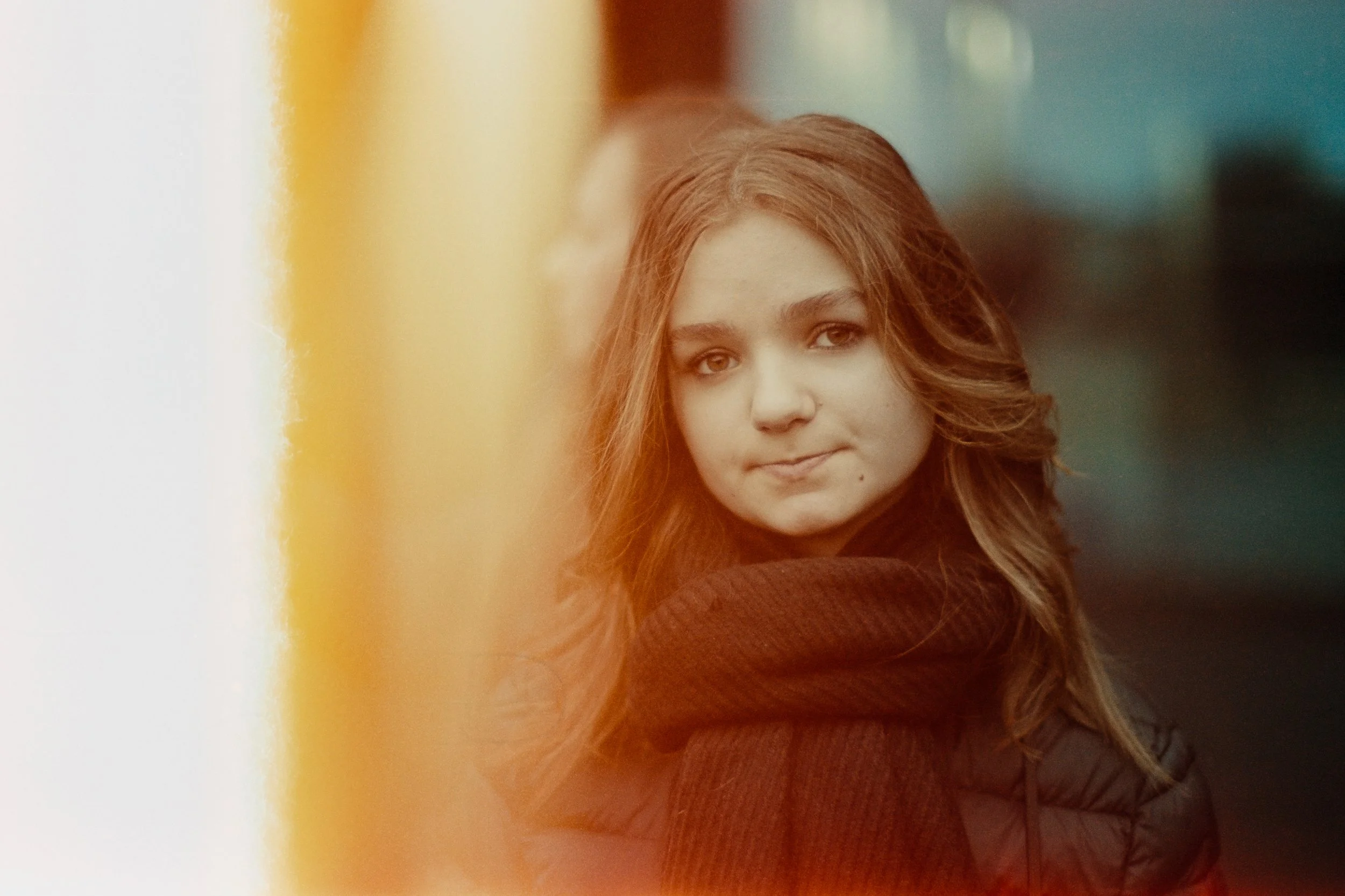
First frame of a roll of Kodak Vision3 250D, where a light leak from the leader spilled warmth into the image — a small accident that gave the portrait its glow.
Blur and the Shape of Movement
Stillness has its place, but life rarely stands still. A fraction too long on the shutter, and a hand moves; a head turns. What results isn’t a technical flaw — it’s a description of time.
In portraiture, a slight blur carries heartbeat and rhythm. It’s how you sense breath behind the eyes. In long exposures, motion transforms into something sculptural — light turned into gesture. The imperfection isn’t an accident; it’s the echo of life passing through the frame.
Liquid Light Whisperer shoots often lean into this quality deliberately. Movement creates energy; energy creates truth. Perfection stops time. Blur reminds us it never really does.
Double Exposures: Accidents That Dream
Few things reveal the poetry of film like a double exposure. Two moments fold over each other — one fading, one emerging. Sometimes it’s deliberate: a silhouette over a landscape, a face within its reflection. Sometimes it’s an accident: a forgotten frame, a camera not fully wound on.
Either way, what emerges feels dreamlike. The boundaries between moments dissolve. A person and their surroundings merge; memory and presence coexist.

Double exposure by Tamara (@yomerevelo). Two calm moments — a pelican resting and buoys swaying in harbour light — merge into one. It’s the kind of film image that feels accidental only until you realise how perfectly it breathes.
Liquid Light Whisperer keeps these moments when they add emotion, not just novelty. They’re a visual metaphor for how we remember — not as single, clear frames, but as layers of feeling and time. Here are more of Tamara’s beautiful double exposures:


Exposed more than twenty years ago on Colorama Smart Film and only developed in 2025 at the Liquid Light Lab. The long sleep inside the camera transformed the film — grain blooming, colours fading to haze — image by Aaron Hopkins, @analogue13.
The Forgotten Roll
Every photographer has found one: a roll at the back of a drawer, exposed and never developed. Months or years later, curiosity wins, and it goes into the tank. What comes out is a time capsule.
Dust might have settled, temperature might have drifted, and yet the image appears — softened by time, unpredictable in tone. It feels like finding a letter written by your past self. That element of discovery is unique to film.
When these rolls come through the Liquid Light Lab, they’re handled as artefacts. Their imperfections — base fog, contrast shifts, small stains — become part of their story. They’re not polished for presentation; they’re preserved for truth. The surprise is part of the beauty.
Marks of the Maker
Every scratch, every slight unevenness in development, every frame number printed on the edge of a scan — they’re signatures. They remind you that a human hand was part of every stage.
Photography began as alchemy. Film keeps that lineage alive. It isn’t instant, and it doesn’t forgive carelessness. It demands respect — precision in exposure, steadiness in process, and understanding of how materials behave.
The imperfections that survive through that care are what make the image tactile. When clients hold a finished Liquid Light Whisperer print, they’re holding a piece of that chain — from lens to film to chemistry to light. It’s not a product; it’s evidence.
The Discipline Behind Chance
Letting accidents happen requires skill. The film must first be exposed perfectly enough to survive imperfection. Light leaks only work when composition holds. Grain only speaks when tone is balanced. The artistry lies in knowing where control ends and chance begins.
Every Liquid Light Whisperer session is built on this understanding. Lens choice, film stock, and lighting setup are selected to give space for imperfection to live. A 1930s Sonnar paired with RPX 400 will bloom in highlights; a Takumar with Vision3 will roll shadows like velvet. Each combination defines the limits of the unpredictable — the zone where mistakes become magic.

Shot on a 1956 Zorki 4 camera that suffers from internal reflections — the flare that cuts through the centre came from light bouncing inside the body. Instead of ruining the frame, it gave the portrait a ghostlike softness, the camera’s flaw turning into its signature. I’m not sending the camera for repair.
Why It Matters
For clients, imperfection isn’t something to excuse — it’s something to value. A photograph that feels slightly rough at the edges feels lived-in. It has a presence that smoothness erases. The emotional truth of a portrait often lies in what went wrong: the flare that softens an expression, the grain that turns light into atmosphere, the faint blur that speaks of motion.
Perfection impresses. Imperfection endures. When you return to a film photograph years later, it hasn’t aged out of fashion; it’s deepened. The flaws that once seemed minor have become the proof of life.
Film’s Humanity
To work in film is to accept imperfection as part of the design. Scratches, flares, uneven density — these aren’t accidents. They’re reminders that light is unpredictable, chemistry has a voice, and creation is always physical.
At Liquid Light Whisperer, imperfection is freely allowed and embraced. It’s the signature of authenticity — the point where precision meets humanity. Every frame holds a trace of its making, every tone shaped by touch and time.
In those imperfections lies permanence. Film’s so-called mistakes are not faults to fix but truths to preserve. They remind us that beauty doesn’t come from control — it comes from surrendering to the moment when the photograph makes itself.
All images in this article except Tamara’s were developed and scanned in-house and UK-wide lab at Liquid Light Lab, our dedicated 35 mm film development and studio based in Leamington Spa. Send in your film and you’ll get exceptional results, up to 60MP TIFF and JPEG scans, and rare pyrogallol for exceptional black and white images.
Give Tamara a follow on Instagram: @yomerevelo
Give Aaron a follow on Instagram: @analogue13
By Martin Brown | Liquid Light Whisperer