

Can Kodak VISION3 Film Be Developed in Black and White?
Candido, CineStill and other AHU VISION3 stocks developed and scanned at Liquid Light Lab
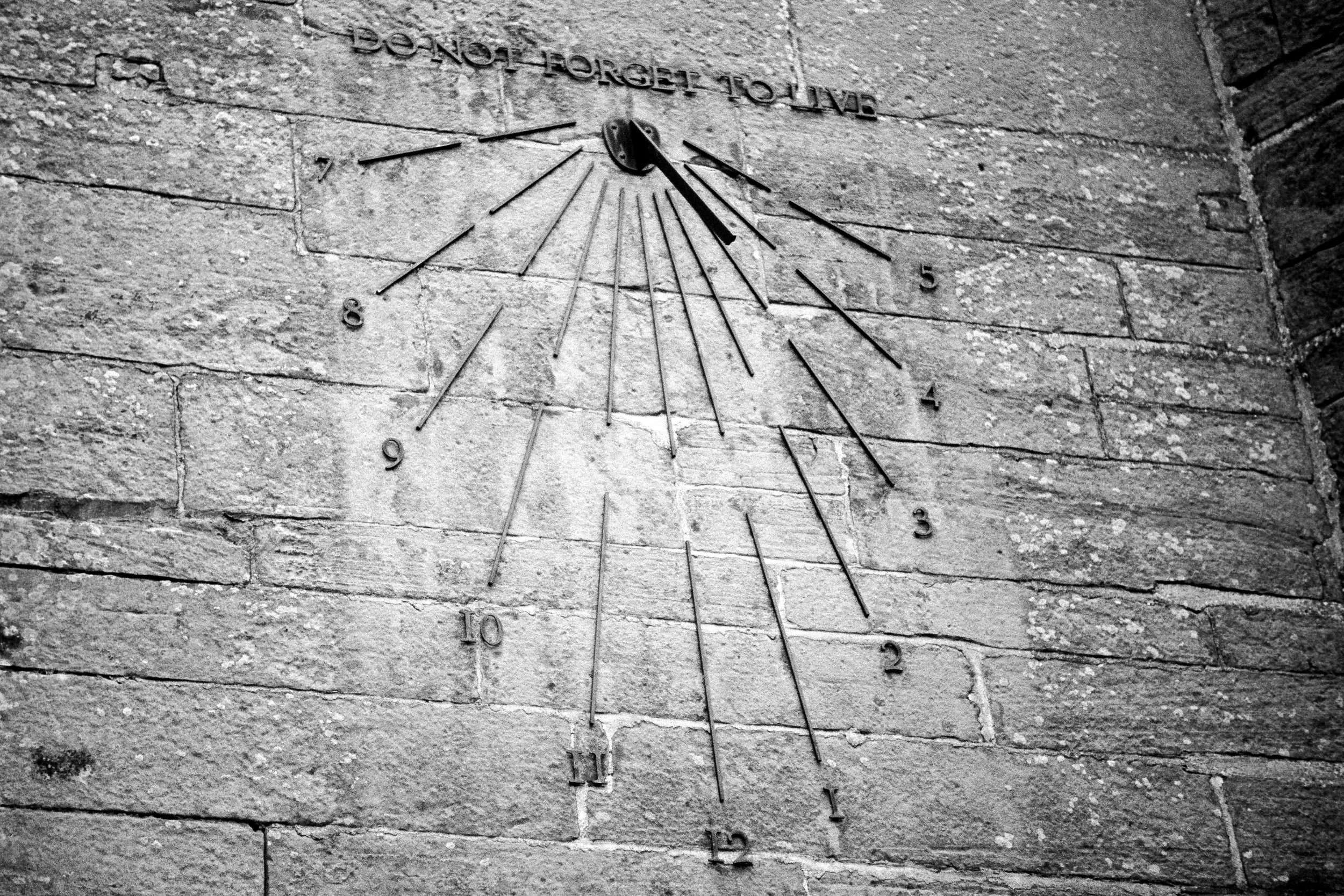
Kodak VISION3 developed as black and white film at Liquid Light Lab. The inscription on the sundial, “Do not forget to live,” sits inside a negative with enough density to hold stone texture, weathering and lettering cleanly.
Kodak VISION3 is usually discussed as a colour motion picture stock, but AHU VISION3 films also open up another serious route: black and white development. That matters for photographers shooting Candido, CineStill and other VISION3-based films who want more from the stock than a standard colour workflow.
At Liquid Light Lab, AHU VISION3 can be developed as black and white film and scanned in-house as part of a specialist monochrome process. This is not a workaround and it is not a novelty. It is a deliberate black and white development route for photographers who want to see what VISION3 can do when processed for silver density, tonal separation and strong black and white rendering.
If you have been searching for black and white VISION3 film development in the UK, or wondering whether Candido, CineStill and other AHU VISION3 stocks can be developed as black and white film, the answer is yes. Liquid Light Lab now offers that as a service.
This article explains what happens when AHU VISION3 is developed in black and white chemistry, how the look compares with more familiar black and white films, and why it gives VISION3 shooters another credible reason to send film to the lab.
Black and White Development for Candido, CineStill and AHU VISION3 Film
This article follows on from the earlier piece, Why Kodak VISION3 AHU Film Changes Bleach Bypass, because both questions come from the same physical change in the stock. With AHU VISION3, Kodak replaced remjet with an anti-halation undercoat, and that newer structure carries additional silver in the film system. In the bleach bypass discussion, that extra silver is part of why skipping bleach becomes a different proposition on AHU stock. Here, the same underlying fact points in a more useful direction: when AHU VISION3 is developed as black and white film, that silver-rich structure becomes part of what gives the negative its density, tonal weight and serious monochrome potential.
AHU VISION3 stocks can be developed as black and white film, and when they are processed properly they produce serious, usable monochrome negatives. This matters for photographers searching for VISION3 black and white development in the UK, or a lab that can handle motion picture stock outside the usual ECN-2 or C-41 routes.
For this test and service path, Candido 200 was developed in 510 Pyro and scanned at Liquid Light Lab. Candido 200 is based on Kodak VISION3 200T, and Kodak’s current technical data for VISION3 200T confirms the stock’s low measured granularity and wide highlight handling. (Kodak)
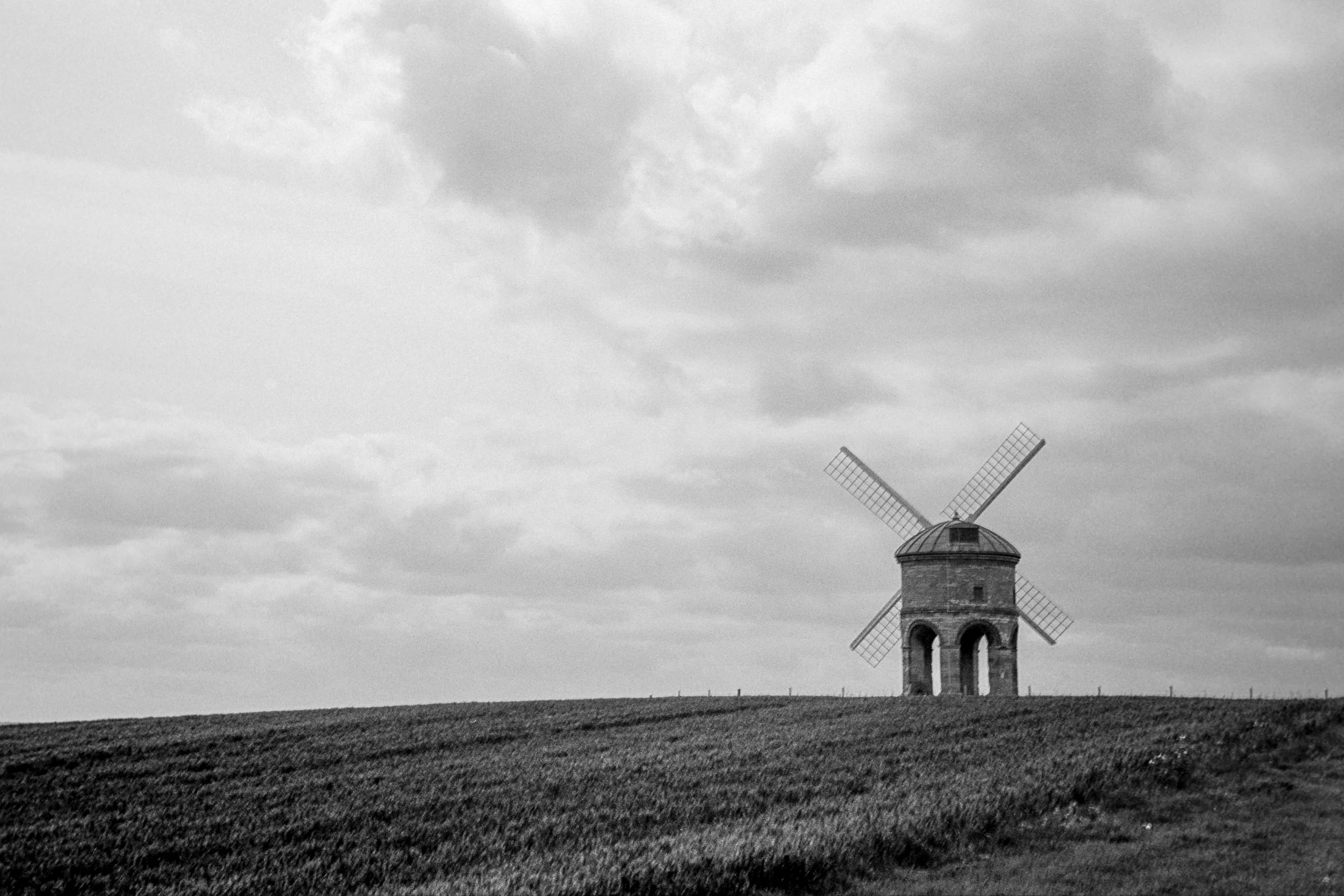
Black and white VISION3 holds scale and atmosphere cleanly, with the windmill, field and cloud structure separated through a dense negative. Developed and scanned at Liquid Light Lab. Shot on a 1939 Zeiss Sonnar 50mm f/1.5.
Why offer VISION3 black and white development at all?
Because VISION3 is more versatile than most labs currently allow for. That wider capability matters at Liquid Light Lab. As Candido’s brand ambassador and technical partner, the work here is not limited to standard assumptions, but to testing, refining and extending what these stocks can credibly deliver.
Most photographers know these stocks for colour. They buy them for tungsten work, daylight work, ECN-2 processing, or cross-processing. What is far less available in the UK is a lab service that treats AHU VISION3 as a legitimate black and white material in its own right.
That is where Liquid Light Lab comes in. If you already shoot Candido, VISION3, or Cinestill, you do not need to leave the VISION3 platform to make strong monochrome work. You can send the same stock family to a UK lab that understands how to process it deliberately as black and white film and scan it accordingly.
For the photographer, that means one film family can now cover more than one serious process path. For the lab, it means offering something useful to realise a creative vision rather than generic processing.
What does 510 Pyro do to VISION3?

AHU VISION3 developed in 510 Pyro, showing how the process holds edge detail, surface texture and tonal separation in a dense black and white negative.
510 Pyro is a staining black and white developer formulated by Jay DeFehr. Zone Imaging describes it as an extremely fine-grained, high-acutance, long-shelf-life staining developer that gives full film speed with most films and is specifically designed for both modern T-grain and conventional emulsions. Zone also states that it is triple optimised for silver gelatin printing, UV printing and scanning using the same development time.
This matters for AHU VISION3 because this is a film structure with real density and substantial image information. In practical terms, 510 Pyro helps shape that density into a black and white negative with strong tonal separation, firm mid-tones and controlled highlights. It is not flattening the stock into a generic result. It is allowing the silver image and pyro stain to work together in a way that scans well and preserves image weight. The point here is not that pyro “adds silver”; it does not. The exposed silver halides are developed into metallic silver, and pyro development also creates proportional stain in the gelatin, which affects contrast behaviour and scan response. Zone’s own technical description supports the fine grain, high acutance and long tonal range side of that result.
For a client sending film in, the important part is simple: this process produces a denser, more substantial black and white negative than many people expect from a VISION3 roll.
How does VISION3 black and white compare with HP5, Double-X and T-MAX?
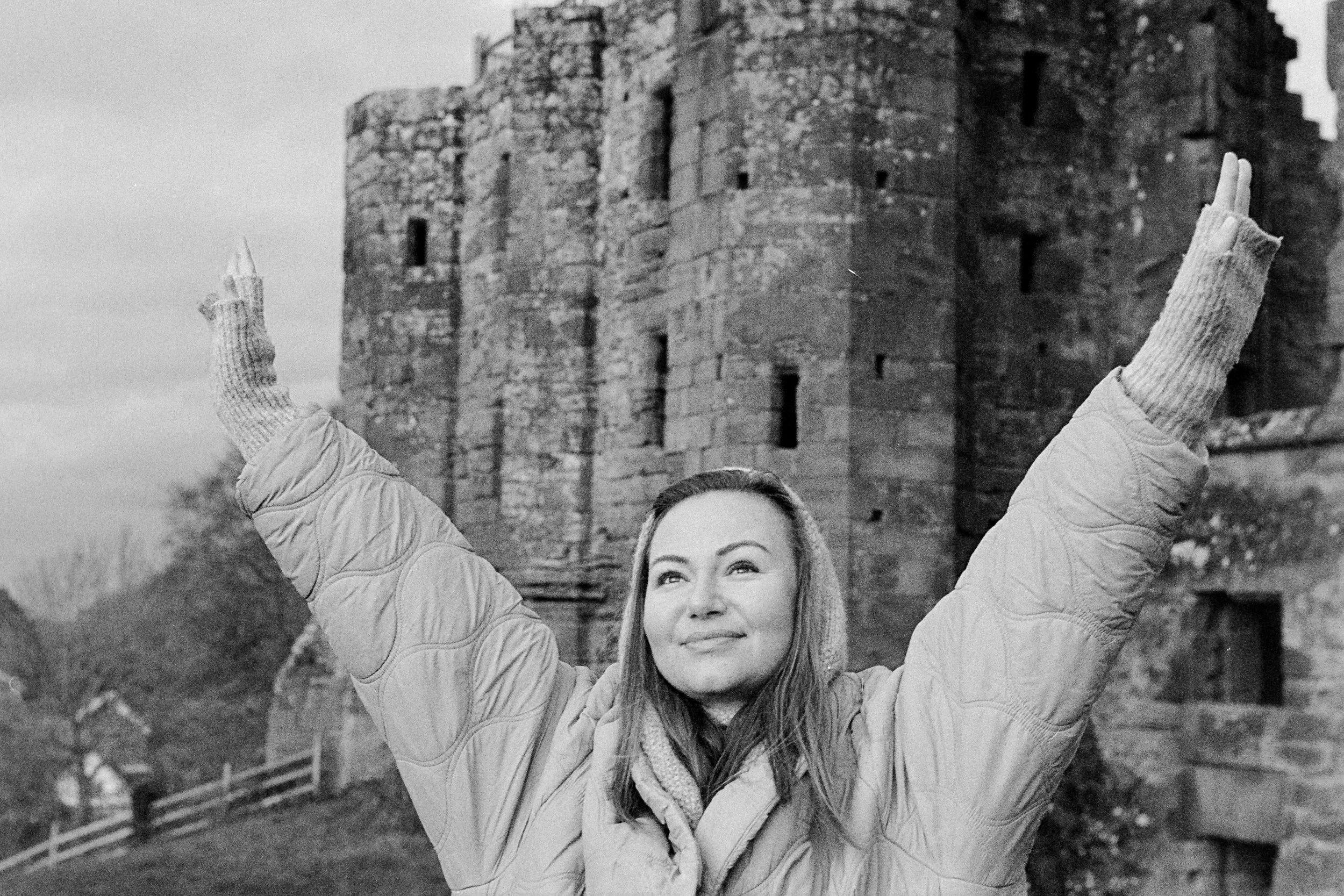
VISION3 500T developed as black and white film, showing how the stock can move from motion-picture colour use into a credible monochrome portrait workflow with clean skin tones, stable highlights and solid tonal structure.
It does not duplicate them, but it does belong in the same conversation.
Ilford describes HP5 Plus as a fast ISO 400 black and white film with fine grain, medium contrast and wide exposure latitude. Kodak describes Eastman Double-X as a high-speed panchromatic black and white negative film with good image-structure characteristics and excellent sharpness. Kodak also describes T-MAX 400 as a T-GRAIN black and white film with very fine grain, very high sharpness and very high resolving power. (Ilford Photo)
VISION3 developed in 510 Pyro sits differently.
It does not have the familiar grain signature of HP5 Plus. It does not give the exact classic monochrome motion-picture look of Double-X. It does not behave like T-MAX, which is a purpose-built T-GRAIN black and white film. Instead, VISION3 in black and white gives you a distinct combination of smoother highlight behaviour, strong tonal body and a grain presence that feels more controlled and less coarse than many photographers expect from a repurposed motion picture stock.
That is exactly why it is worth offering. It is not a substitute for every black and white film. It is a separate black and white option with its own strengths.
Why do this?
Because one stock can now do more.
If you already shoot VISION3, there is obvious value in knowing that the same film family can be developed as colour negative film or as black and white film depending on the result you want. That makes Candido, VISION3, and Cinestill more useful to the photographer and more valuable as part of a wider film workflow.
It also makes black and white more approachable for newer film shooters. A photographer who already knows and trusts VISION3 does not need to start again with a completely different stock just to explore monochrome work. They can send the same family of films to Liquid Light Lab and have them processed in a specialist black and white route built around 510 Pyro.
That is the practical reason to do it. More options from the same film stock, without reducing the result to a compromise.
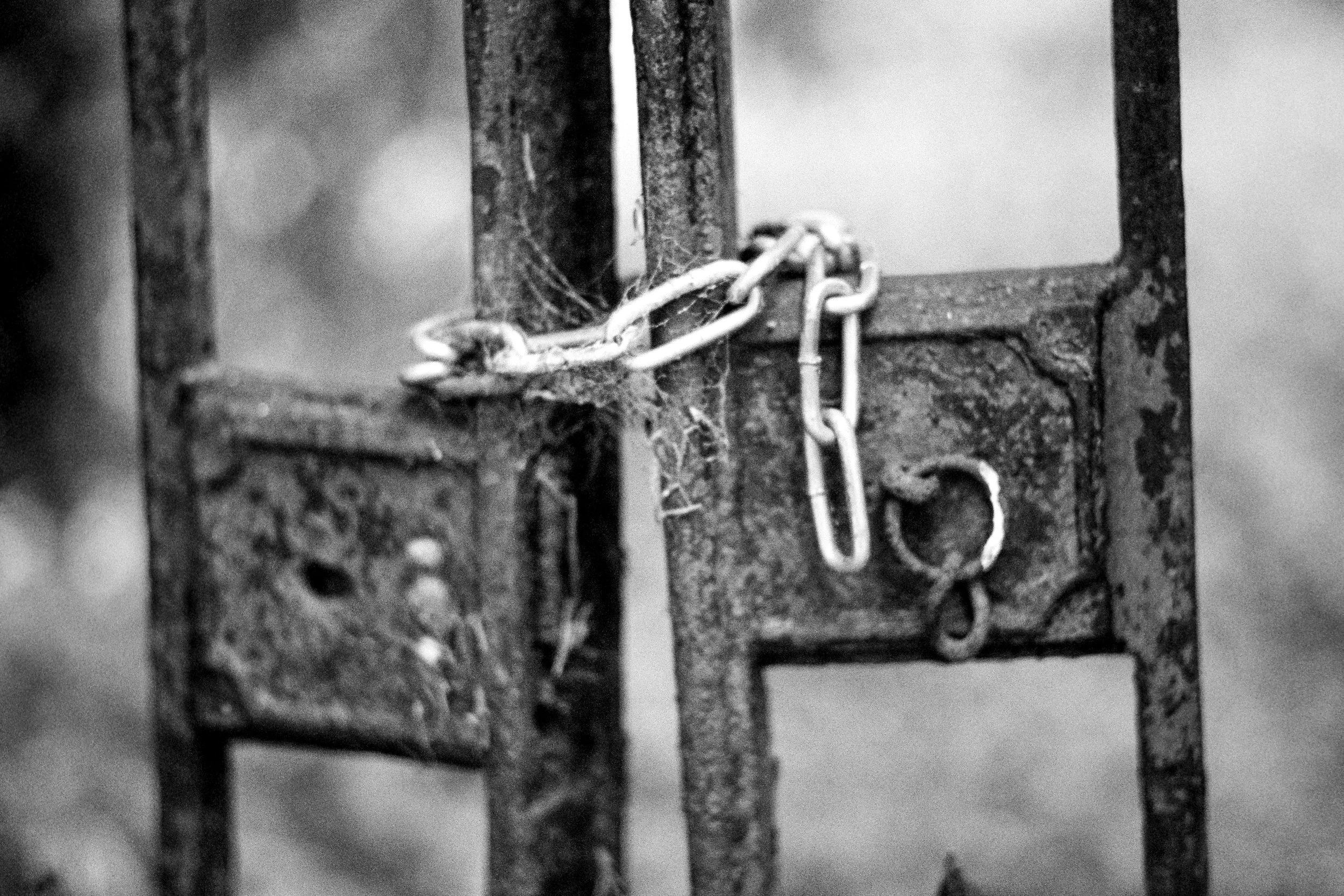
VISION3 developed as black and white film, showing how the process holds rust, metal texture and shallow-focus separation without the negative becoming thin or brittle. Shot with a Zeiss Jena Pancolar 50mm f/1.8.
Who should send Vision3 to Liquid Light Lab for black and white development?
This service is aimed at photographers in the UK who are already shooting AHU VISION3 stocks and want a proper black and white lab route.
That includes Candido & Cinestill shooters who want to see what the stock can do in monochrome. It includes photographers using re-rolled VISION3, and who want a denser black and white negative with a different grain and tonal structure from the mainstream black and white films. It also includes people researching whether VISION3 black and white development is even possible and looking for a lab that already offers it rather than asking them to guess their way through home development.
Liquid Light Lab is built for exactly this sort of specialist handling. The film is developed here, scanned here, and treated as a serious black and white material.

VISION3 200T developed as black and white film, with smooth highlight control, fine tonal separation and a softer, more delicate rendering in close-focus detail.
What should clients expect from the result?
Clients should expect a black and white negative with real density, controlled highlights and a clear tonal structure through the middle values. They should also expect a result that does not look like a routine HP5 or T-MAX workflow.
That difference is part of the point. VISION3 in 510 Pyro gives the stock another useful identity. It stays motion-picture in origin, but it becomes a compelling monochrome material in its own right when the process is chosen properly.
For the photographer, this means there is now a real reason to send in Candido, Cinestill or other AHU VISION3 films for black and white development, not just colour.
Send your VISION3 film to Liquid Light Lab
If you are searching for VISION3 black and white development in the UK, Candido black and white processing, or a UK film lab that can develop AHU VISION3 stocks in 510 Pyro, Liquid LightLab now offers that route.
Send in your Candido film, VISION3 or Cinestill and choose black and white development through the lab. Your film will be developed in-house in 510 Pyro and scanned at Liquid Light Lab as part of a full black and white workflow built around density, tonal control and serious extraction from the negative.
This is not a side note to the VISION3 story. It is another reason to shoot the stock.
By Martin Brown | Liquid Light Whisperer