

Why Kodak VISION3 AHU Film Changes Bleach Bypass
What changed with Kodak VISION3 AHU film
Kodak’s new VISION3 AHU structure changes the technical basis of bleach bypass enough that Liquid Light Lab is withdrawing bleach skip / bleach bypass processing for AHU film.
This decision follows direct discussion with Kodak’s lab in London on the new stock and its silver-bearing anti-halation design, and it is consistent with Kodak’s published AHU notes. Kodak states that the new anti-halation undercoat is a gel-based layer beneath the emulsion, that it contains silver, and that the density in this layer is removed in normal processing. Kodak also states that this new anti-halation layer will produce significantly higher densities in a skip-bleach process.
That is the pivot point. Bleach bypass on older remjet-backed VISION3 and bleach bypass on AHU film are not the same proposition.
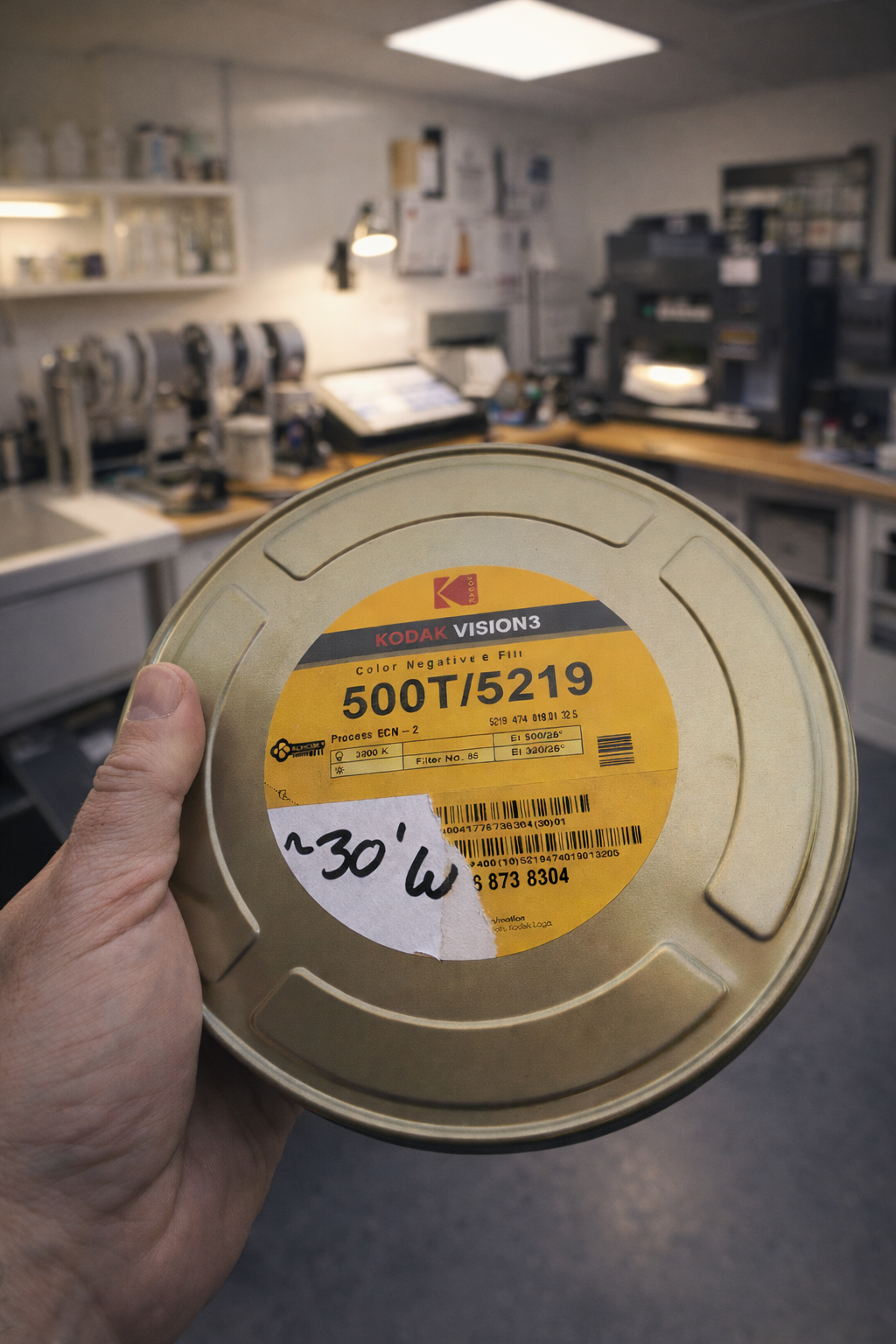
An older bulk-rolled can of Kodak VISION3 500T. The remjet-backed stock structure made bleach bypass a more workable process than it is on the new AHU film.
Why bleach bypass worked on older VISION3 film
On the older stock, remjet sat on the base side as a carbon backing. It handled anti-halation, anti-static behaviour and surface protection from the back of the film rather than from within the coated image structure. Kodak describes the new AHU construction as removing remjet and replacing it with a process-surviving anti-static back layer plus an anti-halation undercoat on the emulsion side which washes away during processing.
That distinction matters because bleach bypass is not just a stylistic effect. It is a process decision about how much silver remains in the negative after development. With remjet-backed VISION3, the anti-halation solution and the retained image silver sat in more clearly separated parts of the film’s architecture. With AHU, anti-halation protection now sits beneath the emulsion in a silver-bearing layer. Once bleach is bypassed, the density burden is no longer limited in the same way.
That is why older bleach bypass references on VISION3 are now weak guidance for AHU film. The film structure has changed at exactly the point where bleach bypass exerts itself.
Why AHU bleach bypass is no longer a sound lab process
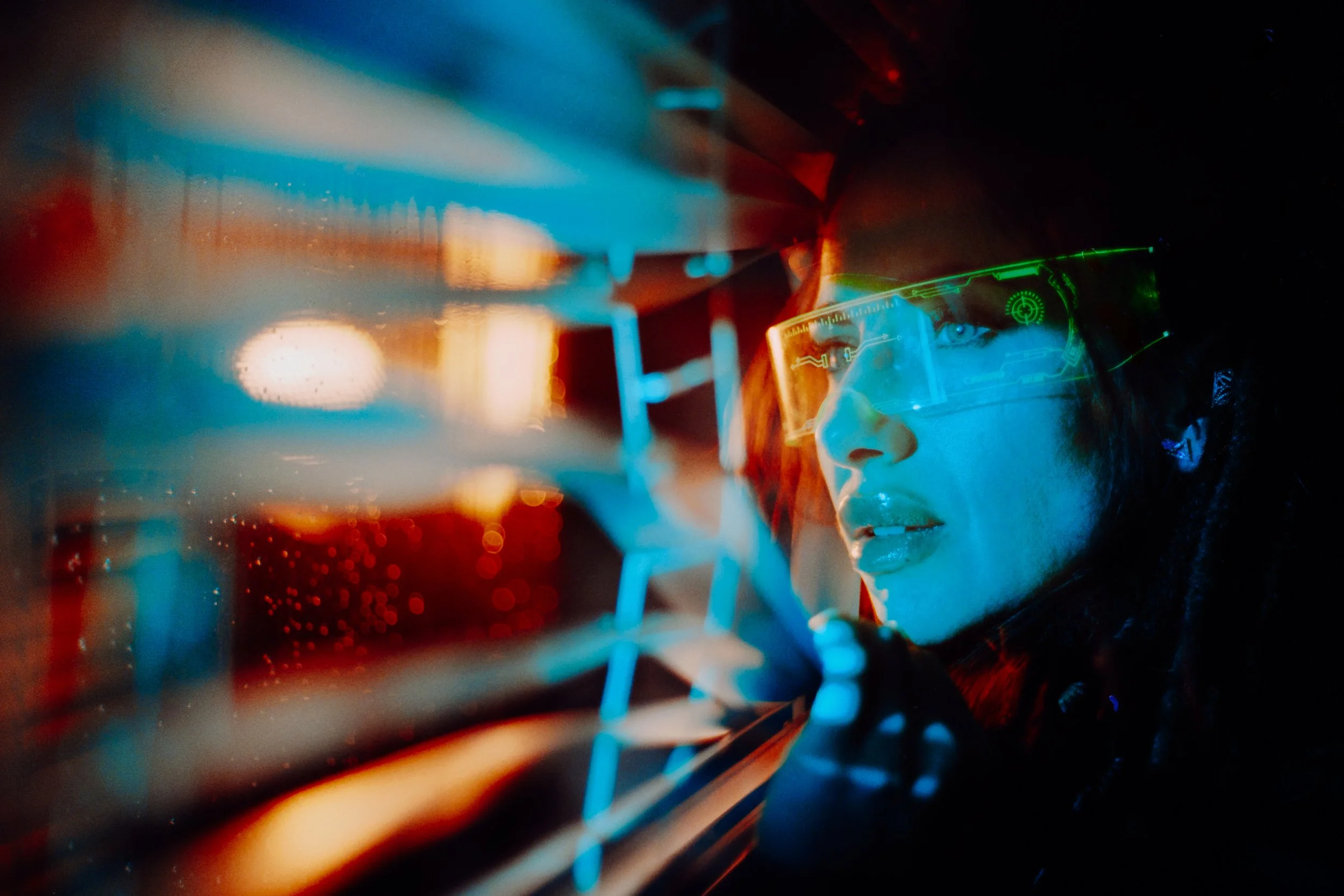
This AHU halation-control test shows how effectively the new anti-halation layer suppresses glow around in-image light sources, while also pointing to why the same silver-bearing structure leaves far less room for a sound bleach bypass process.
In normal colour negative processing, exposed silver halide is developed, dyes are formed, the metallic silver is bleached, and the fixer removes it so the final colour record is a dye image. In bleach bypass, that silver removal is reduced or omitted. The silver remains over the dye image, raising density and reshaping the negative physically rather than merely cosmetically.
On AHU stock, Kodak has already stated what follows: the anti-halation layer contains silver, and skip bleach will lead to significantly higher densities of it remaining in the image than its remjet predecessor.
That has practical consequences well beyond the usual shorthand of “more contrast” or “less saturation”. The negative becomes harder to scan cleanly, harder to place consistently, and harder to standardise across different scenes. Lower values can close too early. Colour relationships can lose separation rather than gain authority. Highlight transmission becomes more obstructed. The negative stops behaving like a flexible source and starts behaving like a chemically overburdened object.
That is not a niche technical concern. For a lab, it is the whole concern.
Why Liquid Light Lab is withdrawing bleach bypass for AHU film
“The new Anti-Halation layer is a technically advanced formulation containing proprietary
components and SILVER. This will result in significantly higher densities in a skip-bleach
process.”
Liquid Light Lab is built around preserving negative integrity and extracting film to a high standard. A client-facing process has to be repeatable, defensible and under control. AHU bleach bypass no longer meets that threshold.
The decision here is not based on internet speculation or on treating Kodak’s change as a vague warning. I discussed the new AHU layer directly with Kodak’s lab in London, focusing on its silver content and the effect of skipping bleach. The answer was clear enough to make the Liquid Light Lab position clear as well. This is no longer a process that belongs in a controlled service offering.
That matters commercially as well as technically. A lab builds authority by knowing where a process should stop. Anyone can offer a dramatic look, but a serious lab needs to protect the negative first.
Why the bleach bypass look should now be built in grading
If the intended destination is a bleach bypass aesthetic, AHU film should be processed normally and the look should be built later in grading.
This route preserves the negative as a usable source while allowing much finer control over the image. Contrast can be placed rather than globally baked in. Chroma can be reduced selectively. Skin values can be protected. Lower values can remain separated. The look can be tuned frame by frame instead of being chemically imposed across the whole roll.
With AHU VISION3 this is the more competent route because it keeps process and rendering in the correct order. First preserve the stock properly, and then shape the image with judgement.
This is especially important on AHU because Kodak is not presenting this as a degraded VISION3 product. Kodak states that sensitometric performance is unchanged, that the new film structure works seamlessly with earlier VISION3 workflows, and that the new structure gives cleaner scanning and printing results through the process-surviving anti-static layer and the elimination of remjet removal.
AHU should be treated as a more integrated stock that requires a more disciplined workflow, not as a new candidate for forcing an old process signature.
Why the silver in AHU film becomes more interesting in black and white

Kodak VISION3 500T developed by Liquid Light Lab in 510 Pyro, showing how cinema-origin film can produce a strong silver image with tonal depth, open mid-tones and controlled highlight behaviour in black and white.
The more serious silver question with AHU film is not colour bleach bypass. It is monochrome development in high quality black and white chemicals.
In our conversation, Kodak stated that VISION3 film looks excellent when developed in black and white. In our own test results of AHU VISION3 developed in black and white 510 Pyro, we concur. This observation matters because it shifts the role of silver completely. In colour negative processing, silver is developed and then removed so that the dye image remains. In black and white processing, the silver image is the final image.
This makes the new AHU structure more interesting, not less. The same silver-bearing design that now makes skip bleach on colour film materially excessive proves far more coherent when the stock is treated as a true silver-based monochrome negative.
This is not theoretical. Liquid Light Lab has already developed older VISION3 film successfully in 510 Pyro. The new AHU stock strengthens this line of enquiry rather than weakening it.
Why 510 Pyro is the better direction for VISION3 AHU film
510 Pyro matters here because it is not just a black and white developer in the generic sense. In controlled use it produces a negative with a specific tonal organisation, strong highlight composure, and a stain-supported density structure that scans with substantial depth and separation.
On VISION3-origin material, that is a meaningful combination. These films are already highly refined emulsions with disciplined exposure behaviour and strong tonal continuity. In 510 Pyro, that can turn into a monochrome negative with real silver authority: controlled highlights, open lower values, and middle tones that retain shape instead of flattening into a single block.
That is where AHU becomes more compelling. The silver is no longer an unwanted excess left behind by an interrupted colour process. It becomes part of the image medium itself.
For Liquid Light Lab, that is the substantive conclusion. The old expressive route on VISION3 was bleach bypass. The more interesting and serious route on VISION3 AHU is black and white development.
Process Kodak VISION3 AHU film with Liquid Light Lab
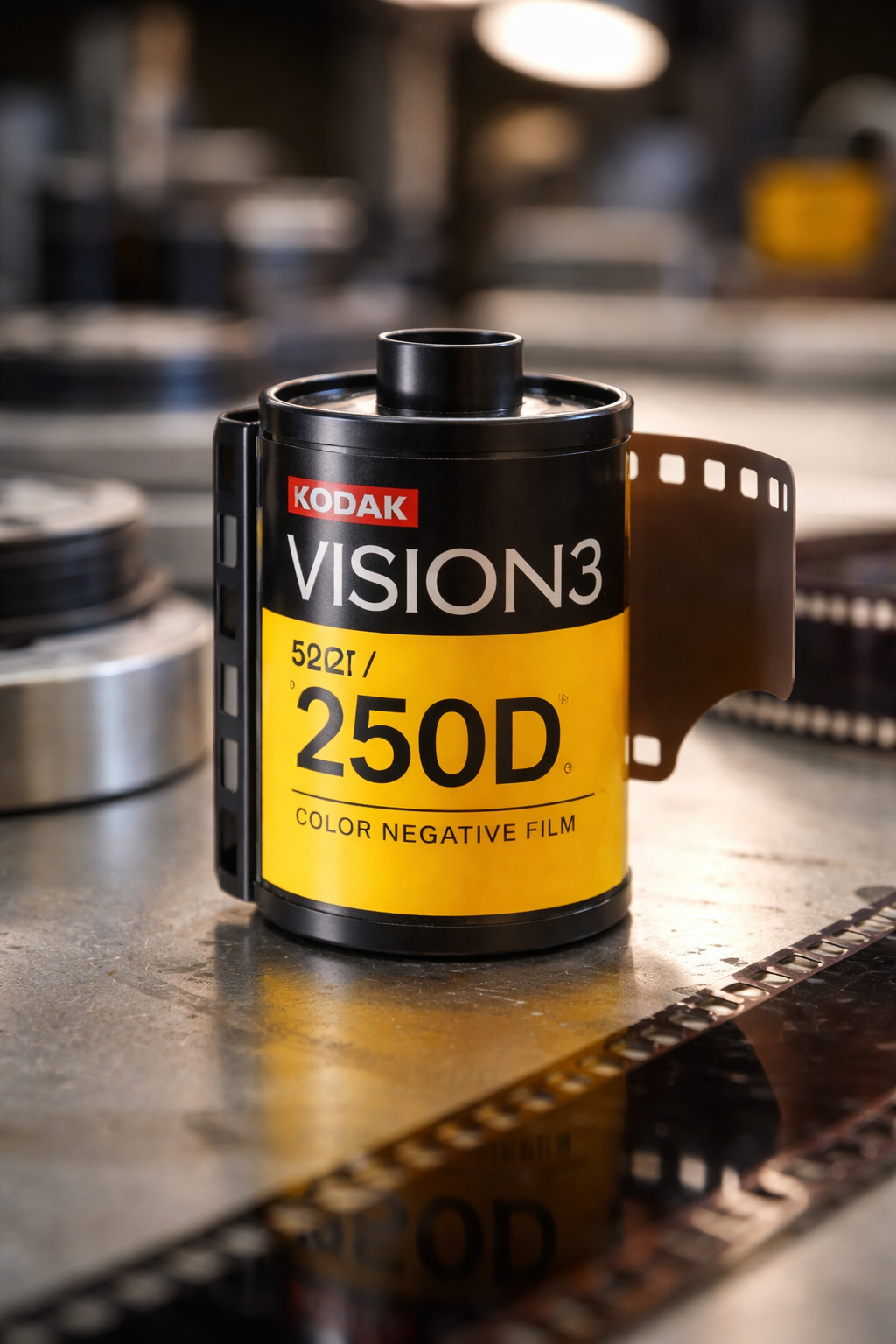
Kodak VISION3 film at Liquid Light Lab, where AHU stock is processed with full technical control in ECN-2 and explored in black and white through 510 Pyro.
Liquid Light Lab will not offer bleach bypass on Kodak VISION3 AHU film. That position follows from direct discussion with Kodak, Kodak’s published AHU guidance, and the standards required by a practitioner-led lab working around process control, density accuracy and high-quality scan extraction.
For colour work, AHU film should be processed normally in ECN-2 chemical processes, and any bleach bypass rendering should be created later in grading. For monochrome work, the new silver-bearing structure opens a more serious path in black and white development, particularly in Liquid Light Lab’s 510 Pyro.
If you are shooting Kodak VISION3 AHU film and want it handled with technical control, Liquid Light Lab offers ECN-2 development, C-41 where appropriate for cross-processing, and black and white development in 510 Pyro through a full-stack analogue workflow built around competence, tonal control and optical discipline.
Send your VISION3 film to Liquid Light Lab
By Martin Brown | Liquid Light Whisperer