

VISION3 AHU Film Development at Liquid Light Lab UK | ECN-2 & C-41 for 50D, 200T, 250D, 500T
Kodak’s move from remjet-backed VISION3 film to VISION3 AHU (Anti-Halation Undercoat) is changing the stills market quickly.
The most important fact has not changed. Kodak states that the new AHU structure brings “no change to the product’s sensitometry” and “no workflow adjustments required in processing, scanning, and printing workflows.” Kodak also states that the new structure controls halation even more successfully than remjet. This means VISION3 AHU is still VISION3 camera negative film, still built around the same stock identity, and still demanding the ECN-2 development process.

Portrait shot on earlier remjet-removed VISION3 film. Even before VISION3 AHU, the stock was never defined only by halation. The real value was always in the negative itself: colour control, tonal structure and the way the film holds a scene.
That matters because the old re-roll market let a lot of bad assumptions survive. Film sold as 800T was VISION3 500T, and film sold as 400D was VISION3 250D. Bright light sources, visible halation and a stylised glow around practicals helped many photographers believe those inflated names. The stock could be pointed at lamps, signage, headlights and other hot sources, and the halation effect helped disguise what the negative was actually losing. With VISION3 AHU, that cover is removed. The anti-halation system cannot be removed in re-rolling the film, and Kodak has improved how these new films prevent halation effects. What made films like 800T have a ‘special halation look’ has effectively been designed out, exposing the stock beneath the marketing more clearly than before.
Now the true speed of the stock now matters more, not less.
This is where Liquid Light Lab separates from generic labs. Distributors can market whatever name they like. Labs are the ones that receive the thin negatives, the weak shadows and the disappointed customer when the files do not match the promise of the label.
As a next generation lab, Liquid Light Lab processes all VISION3 film by the emulsion actually inside the canister. Liquid Light Lab offers both ECN-2 and C-41 development in the UK for VISION3 AHU, with the process chosen from the real stock inside the canister.
VISION3 AHU is not C-41 film
Kodak’s own documents leave no room for drift. The new VISION3 AHU structure is interchangeable with remjet-backed stock, identical in sensitometry and handling, and the AHU layer is removed in development after the photograph is taken. Kodak’s technical data for both VISION3 500T and VISION3 250D state that the chemical process is ECN-2.
AHU changes the backing structure around the emulsion. It does not change the film into an ordinary C-41 stills stock, and it does not change the film’s native chemistry no matter what the box labelling says.
This is why VISION3 AHU film development begins with the question: do you want the stock treated in its native process for its exceptional detail and qualities, or do you want a deliberate alternative? If you want the stock handled on its own cinematic terms, ECN-2 remains the correct route. If you want a baked in C-41 image, that should be a conscious rendering choice, not the result of misunderstanding the what the stock truly is.
Liquid Light Lab offers both, and you can explore them here.

Shot on Kodak VISION3 AHU film with a direct light source placed in frame. Halation remains tightly controlled, revealing the stock more honestly and reinforcing why 800T should be treated as 500T by the photographer.
800T is VISION3 500T
This needs to be stated plainly because too much weak advice is still circulating. Re-rolled 800T film is in reality 500T. Kodak’s technical data for VISION3 500T states:
Tungsten (3200K) 500
Daylight - 320 (with 85 filter)
Process ECN-2
There is no Kodak technical basis for treating the stock as an 800-speed film, or a C-41 film in any of their documentation.
For a while, the market got away with this because halation helped carry the frame. Photographers could point the film at bright sources, get a dramatic glow, overlooking the fact that they were underexposing 500T by roughly two-thirds of a stop or more. With VISION3 AHU, Kodak has tightened halation control. The absence of halation glow now shows clearly weak underexposed negatives. What comes through now is the real real speed, and the real exposure.
This is why 800T development needs a lab that understands what is actually being processed. If VISION3 500T is exposed at 800 and not also pushed at the lab, it is underexposed. The shadows carry less density, lower-value separation weakens, and less of the stock’s performance survives into the final files. Halation is no longer here to hold the photograph together with a stylised look.
Kodak’s own 500T data sheet (see end of article) highlights reduced grain in shadows and “2 stops of extended highlight latitude.” Those strengths are part of what make this premium stock worth buying, and they are exactly what poor labelling and handling throws away.
Liquid Light Lab processes film sold as 800T for what it really is. If you exposed it as 500T, it is processed as 500T. If you rated it faster and want push processing, that can be done. That is the difference between a lab that reads the label and a lab that reads the manufacturers literature.
An ISO of 500 is also not a ‘night’ stock or a passport to see in the dark, despite the marketing. If ISO 400 is a versatile daylight film, it only takes logical deduction to see that 1/3 of a stop more is not magically going to convert the film into night vision. The advertised ISO 800 of some companies has never been a night rating either, but shooting light sources for halation glow effects helped to maintain that illusion.
400D is VISION3 250D
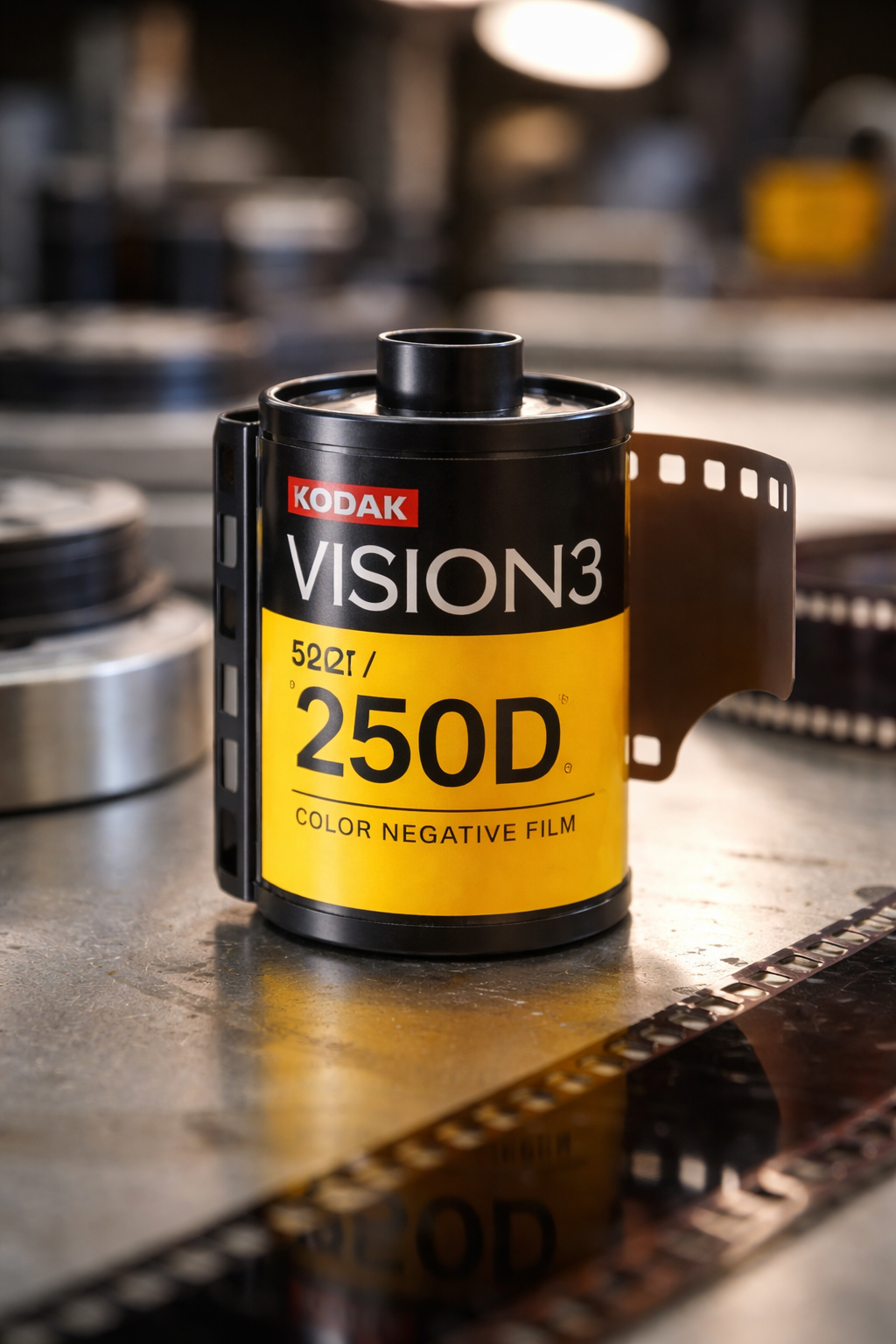
Kodak VISION3 250D. In the stills market it is often sold as 400D, but this will underexpose your images by 2/3 of a stop, losing shadow detail and creating a thinner negative.
The same point applies in daylight stock. 400D is 250D. Kodak’s technical data for VISION3 250D states
Daylight (5500K): 250
Process ECN-2
This is Kodak’s published speed and Kodak’s published process for the stock. A relabelled canister with marketing claims contrary to Kodak’s specification does not create a new emulsion.
If VISION3 250D is exposed at 400 without push processing, it is also underexposed. The negative loses shadow density, the lower values lose strength, and part of the tonal architecture is thrown away before scanning and printing begins.
Kodak’s own 250D sheet highlights reduced grain in shadows and “2 stops of extended highlight latitude.” This is premium camera negative performance if it is shot with Kodak’s correct exposure index.
Liquid Light Lab processes film sold as 400D according to what it actually is, which is VISION3 250D.
Why VISION3 AHU makes lab choice more important
The move to VISION3 AHU makes the market cleaner, but it also makes the remaining confusion more obvious. The new product uses a process-surviving anti-static and scratch-resistant back-side layer that produces cleaner film for scanning and printing, and an anti-halation undercoat that is removed in processing. That means the old remjet narrative is no longer dominating the frame. The backing is less of a spectacle. The stock itself stands more clearly on its own.
This is good for photographers who actually care about what VISION3 does well. Kodak’s own 500T and 250D technical data emphasise shadow detail and extended highlight latitude. Those strengths are real. They are also exactly why poor exposure advice and generic lab handling do so much damage. Now that the old bright-source halation cover is gone, there is less room to pretend that 500T is 800T or that 250D is 400D without consequence.
The negative tells the truth.
Liquid Light Lab is a next generation lab built for this. It is not enough for a lab to accept the roll. The lab needs to understand the market shift from remjet to VISION3 AHU, understand the true stock beneath re-roll branding, and choose the chemistry path from that starting point. This is why photographers use Liquid Light Lab instead of a generalist service.
Why photographers choose Liquid Light Lab for VISION3 AHU film development UK
Because Liquid Light Lab processes the stock by what it actually is. Kodak’s own documents describe these as ECN-2 process films with real shadow strength and highlight latitude which is respected by our development and our scans.
If you want VISION3 AHU film development in the UK from a lab that understands the stock, the true speed, the right chemistry path, and the real reason these films matter, send it to Liquid Light Lab.
Kodak Datasheets